
In your bag No: 1669 – Nigel Middleton
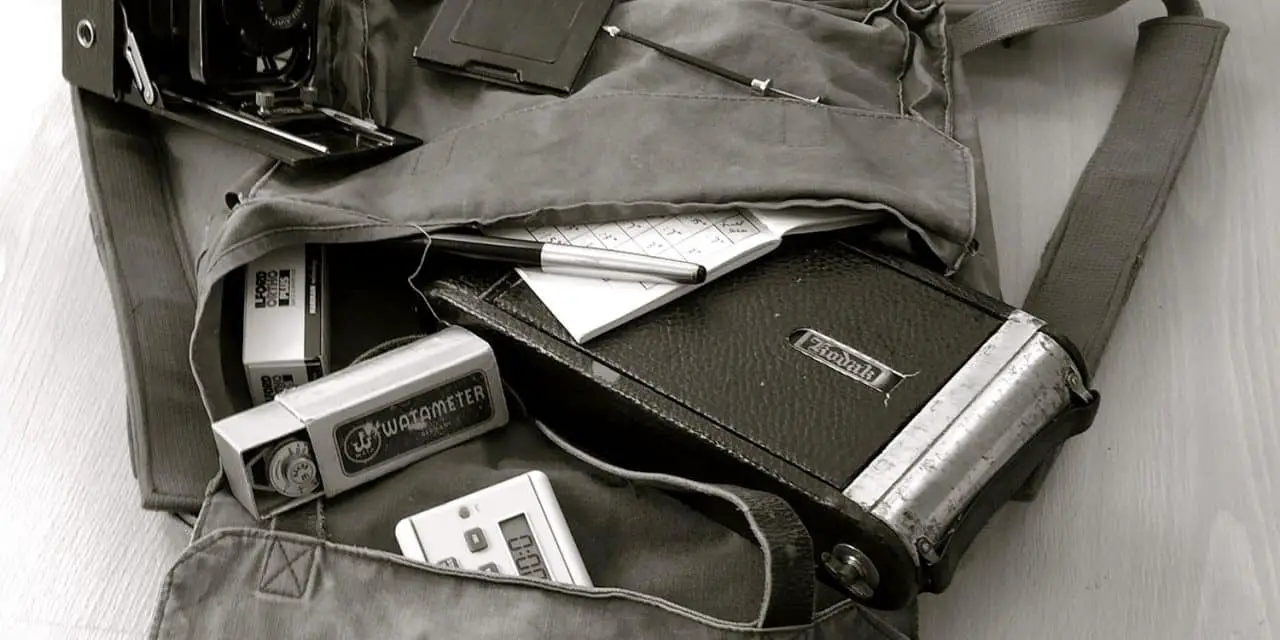
Nigel really puts the “old” in old school with this 100 year old setup in his daily bag.
How do I open it? What does this bit do? I can’t find any film this big so what can I use instead? Shooting 100 year old cameras often involves a lot of problem solving – but with a bit of ingenuity and creative thinking a solution can usually be found. I’ve been reviving and using old, often unwanted, cameras for a couple of years now and my current setup is mainly based around using paper negatives and hand cut film, which I then contact print from – easy to do if you can light proof a bathroom.
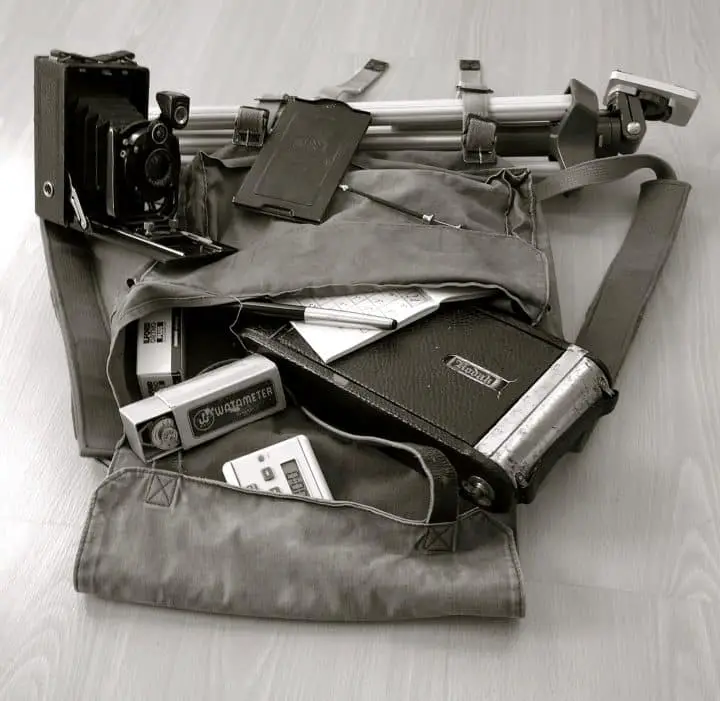
Here’s what’s in my bag:
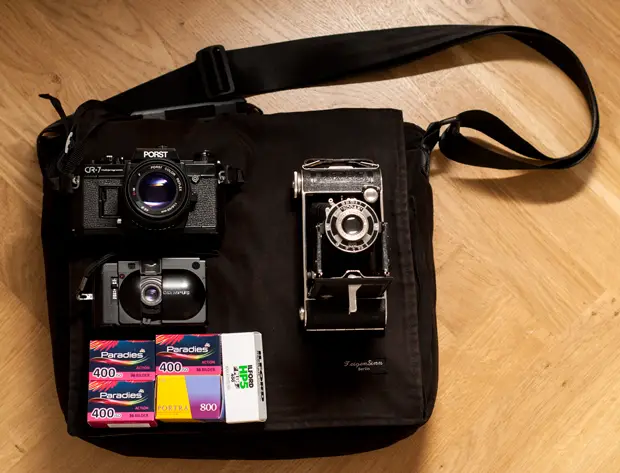
- No 3A Autographic Kodak Junior, c 1920 ‘Junior’ in name only! This large folding camera gives a whopping great three and a quarter inch by five and a half inch negative. It’s loaded with a single sheet of darkroom paper – whatever I can get cheaply, currently a box of Barclay grade 2 (date unknown).
- Zeiss Ikon Suevia 24, c 1926 and 6 x 9 cm dark slide loaded with Ilford Ortho Plus. I’ve had no problems handling this film under red light, so I can cut single frames from a 120 roll as and when required.
- Short shutter release cable
- Watameter range finder.
- Digital timer.
- Notebook and pen – essential. I don’t own an exposure meter so I’m compiling, and constantly modifying, a paper negative/ ISO 6 exposure chart.
- Boots tripod c 1960
My bag is some kind of ex-military kit bag, well-made and comfortable to carry.
Retirement has meant that out of necessity I’m a budget photographer so car boot sales render most of my gear – bag 50p, tripod £1, rangefinder 50p, Mont Blanc fountain pen £1. However, I did splash out and got the two cameras separately in online auctions, which altogether cost me around £20. Both of them were in a non-functioning, distressed condition but now work fine.
I’ve submitted a black and white image of my bag to reflect the notion of thinking in monochrome, a key skill I’ve enjoyed developing. I really love the ‘single shot’ challenge of using these cameras. I like the idea of going out to take a photograph in a carefully chosen location that I might have been thinking about for a while, waiting for the conditions that’ll give me the best chance of success. And if things don’t work out … well, there’s always a next time!
You can see more of my work at www.shootsomefilm.webnode.com
Thanks for sharing your bag with us, Nigel. To quote Eminem, “if you had one shot…”
Keep them coming folks, we need more submissions, so get your bag on Japancamerahunter.com
Send me a high resolution image of the bag. Optimum size is 1500px across. Please ensure there is a bag in the shot, unless you don’t use one. The more you can write about yourself the better, make it appealing and tell us a story. Snapshots of your gear with a camera phone and no words will not be featured.
Oh and don’t forget your contact details (twitter, flickr, tumbler et al). Send the bag shots here. Please understand that there is a long wait now as there is a backlog of submissions. Not all make the cut, so make sure yours is funny/interesting/quirky. And please make sure the shot is of good quality, as the ones that are not do not go up.
Cheers
Japancamerahunter




BRAVO!! BRAVO!!! Really this is keeping it simple,and again it is the Image that is important, pre-visualize your scene in what ever media you have. I too have both cameras from the 1930’s that I will be taking to Japan,. A 1933 Plaubel Makina II, and 1933 Foth TLR camera. Real I am excited to be shooting Medium Format this time as in past in visiting Japan that I have been shooting 35mm, however I going to either shipped my film there to my hotel, or buy film there since TSA X-Rays scanners DOES harm film. And those vintage Film Sheilds X-Rays bags- DO NOT BELEIVE IT!! All they are going to do is ignored your reuse stand turn those X-Rays to BROIL until they see an image and your film is FRY!! Thank you…
Alex,
If you’re flying out of the US, you can ask to have your film hand inspected. Take it out of your carry on, and POLITELY ask for a hand inspection. This is a travelers right (check the FAA website or the TSA website for the exact wording and your rights.)
AS for the film-safe style lead bags, they will protect your film. I’ve heard that it’s a myth the inspector will crank-up the intensity of the X-ray device. The inspector would be exposed to radiation beyond safe levels. What they will do is scan your bag, stop it or reverse the belt to scan your bag a second time. I have observed this at both regional airports and Logan.
The more troubling information coming out is that the new generation scanners used to check carry-on baggage will harm film during an initial, first-time scan, whereas the older style would not have an effect on film if the film was scanned only once or twice.
Both Kodak & Ilford have posted traveler advisories and are trying to work with gov’t security agencies to get new guidelines for traveling with films.
It goes without saying never put your film into checked luggage – they do blast them with more powerful x-rays.
We were preparing to travel to London from Boston before COVID broke out. I had planned to carry a single roll of film while flying over to the UK, then buy XP-2, and have it processed in London before we left to return to Boston. For now, I think that is the safest way to travel internationally from the US with film.
I applaud your approach. It’s not for me, but you prove that age of equipment or photographer is no barrier to creative work. BTW, I’m almost 69, so I hope I can get away with my age comment!