
In your bag No: 1704 – David Kopytko
David shares with us his ultimate street photography setup. And yes, it is all digital.

Hi, my name David Kopytko, I’m from Montreal, QC. Canada and I would like to thank you for allowing me to contribute to the ‘’In your bag’’ series.
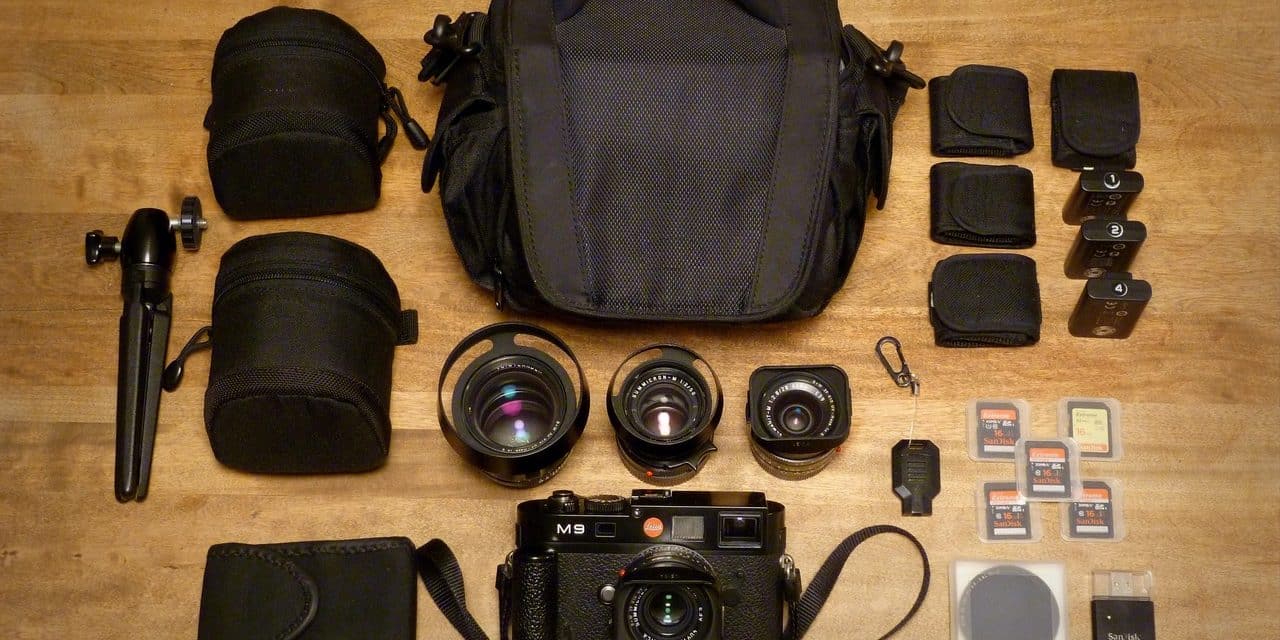
The small kit pictured here is intended to be as light as possible while allowing one to cover the vast majority of situations encountered in the practice of social documentary (‘’Street photography’’).
The lone camera is an M9 nicknamed Cecil. Just like its Looney Tunes reptilian namesake, it is small, slow, and sharp.
It was made super-comfortable through the addition of a Thumbs Up (Match Technical), a hand grip (Leica) and a soft release button (generic but nicely painted brass from some honest eBay seller).
The lenses are seldom carried all together, two or three usually being sufficient, chosen in accordance with the situation.
The 35mm Summicron-M Asph. is my go-to lens. It shows no distortion, allows one to stand close enough to the main subject, thus avoiding the distraction of unwanted elements, and it makes it possible to shoot sideways on a narrow path while still including enough of the scene. It represents the ideal focal length for street work. The focusing tab allows for eyes-off quick zone-focusing. Small, light, sharp, contrasted, beautiful !
The 28mm Elmarit-M Asph. draws in an almost surreal way, thanks to its wide angle of view and exaggerated perspective. It is also free from distortion, sharp, saturated and contrasted. It also benefits from a focusing tab and will not obstruct the viewfinder (it is in fact the tiniest lens in the Leica stable).
Well suited for the ‘’In your face’’ style of street photography (think Garry Winogrand), provided that you have enough… stamina…, its diminutive qualities come handy when practicing this type of intimate, close-range work while trying to remain as unassuming as possible.
N.B. : Always bring a handful of business cards while using the 28mm, you might find them quite useful in diffusing a hairy situation. No one wants to be spoken to ‘’moistly’’, particulary in the actual context… Also, WEAR A MASK, sorry for stating the obvious here…!
You will find two ‘’nifty-fifties’’ here :
The small and light Summicron-M 50mm renders beautifully in environmental portraiture (especially in B&W, and mainly around certain apertures…). It is extremely well corrected, as close to balanced perfection as it gets. The one shown here is the fourth iteration of it, the one with the focusing tab and nice all-metal latch-on lens Hood (not the new ‘’foreskin’’ type).
Rookie riders call this lens a one-trick pony. It is actually many lenses in one to the wise and patient eye.
The Nokton Asph. 50mm f/1.2 Asph. Is big, heavy and cumbersome.
It is also an exquisitely crafted, amazing light-gathering tool, and a fabulous portrait-maker at full aperture and close range.
This lens can also produce some wicked, dreamlike imagery when used at full aperture in broad daylight through a neutral density filter, or sharpen-up to record-braking levels when closed down…
Which brings us to the topic of flash (or lack thereof)…
A flash is as useful as a screen door on a submarine.
Honest people should never get subjected to the kind of unwanted, relentless aggression of crude light in the shape of sudden bursts.
In the context of scenic arts and stage performance, where any artist could be affected with photosensitivity (or Bucha effect), the unprovoked usage of flashlight represents a hostile act (seriously).
Let alone the fact that someone’s job is just that: to create the lighting (literally since the beginning of time).
There is plenty of light available, we call it ‘’available light’’, and for when there’s not enough, we created ‘’fast’’ lenses.
This needed to be said.
Now, the accessories are few and consist mainly of batteries (in nylon Zippo holders), memory cards (Sandisk 16Gb, 45Mb/s), a Sandisk MicroMate card reader (tucked along with the cards in a Lowepro pouch) a small LED flashlight (INOVA), the lightest possible table tripod (Manfrotto), and an ND filter for the Nokton (8X, B+W).
The whole thing is contained in a small nylon bag (Lowepro EDIT 120), to the back of which a lens pouch can be secured, while supplemental pouche(s) can be carried on a belt.
A lightmeter is not truly necessary with the M9 (although I like the little Sekonic Flashmate L-308 series), and I avoid using leather since it retains moisture, not to mention the fact that my pets seem to look at me in a funny way anytime I wear animal products… Or maybe it’s just me…
Anyway, thank you for reading, peace!
Keep them coming folks, we need more submissions, so get your bag on Japancamerahunter.com
Send me a high resolution image of the bag. Optimum size is 1500px across. Please ensure there is a bag in the shot, unless you don’t use one. The more you can write about yourself the better, make it appealing and tell us a story. Snapshots of your gear with a camera phone and no words will not be featured.
Oh and don’t forget your contact details (twitter, flickr, tumbler et al). Send the bag shots here. Please understand that there is a long wait now as there is a backlog of submissions. Not all make the cut, so make sure yours is funny/interesting/quirky. And please make sure the shot is of good quality, as the ones that are not do not go up.
Cheers
Japancamerahunter





I’m on your side on this one. Flash is for people who don’t understand the idea of ambient light. It’s been proven to be better not to use flash in photography. I’ve seen some people using it in broad daylight, what are they thinking?
Way too often can people be seen carrying huge zooms around with a lens cap permanently on. This reality is full of contradictions… The flash can be an amazing light brush in the right context, as a filler for back-lit subjects or even as a main light for modeling. But for documentary work
where the photographer’s role is to capture reality as is, or for scenic art where the ambiant light becomes a critical part of the performance, it becomes detrimental to the subject. I will always see the flash as a studio tool. I don’t hate the little marvel of technology that will reveal the mediocrity of the operator when misused. I may come across like some sort of snob, but I’m not. I just have a lot of respect for photography. It turns two abstract things, light and time, into something tangible and very concrete. This is surreal. Indiscernable from magic.
Can’t say I agree about flash… They can be very useful especially when shooting film. I once heard photographers who insist on only ever using ambient light compared to chefs who only ever cook using a microwave. Flash certainly is superior to the blurry low contrast mush that would result from shooting 100 iso film indoors with a slow lens.
That being said I definitely agree that it’s not really an appopriate tool for close quarters wide angle street photography…unless you’re willing to risk a black eye. I think digital and cellphone photography have also made ordinary people totally unused to xenon camera flashes.
You were probably thinking about Bruce Gilden… I can’t say that what he does is uninteresting, let alone amateurish. His work is totally original, and it is obvious that his technique is an integral part of his message. I was partly joking when I wrote all these awful things about using a flash. Partly. Funny too how people have become accustomed to cellphones, while the full-size, ”traditional”, camera is nowadays viewed as a tool fit for a pervert (thanks to Hollywood…). I am very conscious of cellphones. And of microwave ovens…